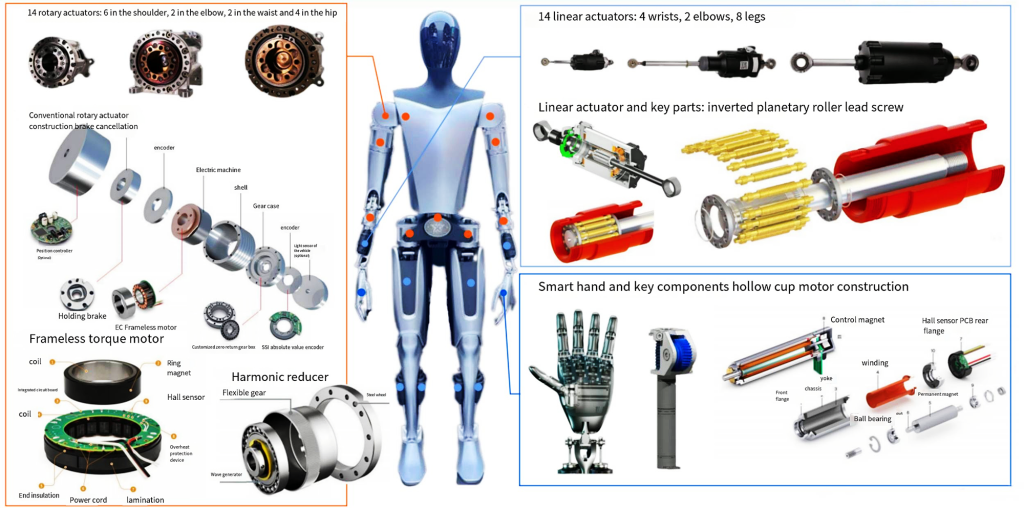
In humanoid robots, the application of coreless motors, frameless torque motors and planetary gear reducers is crucial, and they play unique roles in different systems and functional modules. Below is their detailed application description:
Coreless Motor
Coreless motors are widely used in humanoid robots because of their high efficiency and fast response, especially where high precision and high-speed control are required.
Joint drive
Coreless motors are often used at joints of robots, such as fingers, wrists, elbows, etc. This type of motor has the characteristics of low inertia and high torque density, and can achieve high-speed rotation and precise positioning.
Sensors and actuators
Small coreless motors can be used to drive tiny sensors or actuators to improve the robot’s ability to perceive the external environment and execute fine movements.
Because coreless motors are lightweight and small, they are suitable for use in humanoid robots that require flexible
Flexibility and lightweight
Because coreless motors are lightweight and small, they are suitable for use in humanoid robots that require flexible movement and lightweight design.
Frameless torque motors have been widely used in parts of robots that require strong torque and stability due to their advantages of high torque and low speed and large torque output.
Main joint drive
Key joints such as waist, shoulder and hip usually use frameless torque motors to achieve robust movement and bear larger loads.
Direct drive system
Frameless torque motors are mostly used in direct drive systems, which reduce the intermediate transmission mechanism, thereby reducing mechanical losses and improving the reliability and life of the system.
Optimized space utilization
The frameless design allows the motor to be directly integrated into the structure, saving a lot of space and helping to achieve a compact design.
Frameless Torque Motor
Planetary gear reducers improve the output performance of motors by increasing torque and reducing rotational speed, and are used in multiple motion systems of robots.
Torque amplification
Adding a planetary gear reducer between the motor output shaft and the robot joint can effectively increase the output torque, allowing the robot to perform more powerful actions.
Precision control
Finer speed and position control can be achieved through reducers, which is suitable for components that require high movement accuracy, such as robot arm end effectors.
Smooth deceleration
The planetary gear reducer has a compact structure and smooth operation. It is suitable for application scenarios sensitive to vibration and noise, and improves the stability and comfort of the overall robot operation.
Planetary Gear Reducer
Applications
Robot arm:
The wrist joint uses a coreless motor to achieve fast and flexible movements, a frameless torque motor is used for shoulder drive to provide powerful torque, and a planetary gear reducer increases the total torque output at each joint.
Bionic legs:
The hip and knee joints use frameless torque motors to achieve high load capacity, and planetary gear reducers provide precise deceleration and torque increase functions.
These driving technologies work in coordination to enable humanoid robots to achieve complex actions, smooth movements, and high-efficiency operations, promoting the wide application of humanoid robots in various fields, including industrial automation, service robots, and medical assistance.
A brushless DC motor is a synchronous motor that uses DC power through an integrated inverter to provide alternating current to the motor's stator windings. Its characteristic is that it is different from the carbon brushes and commutators in trad...
Brushless geared motors are often used in barrier gates (also known as parking lot barriers) to provide a reliable, efficient and low-maintenance opening and closing mechanism. When a vehicle approaches the barrier, the sensor detects the presence...
Event: Manufacturing World Tokyo 2026Date: July 1–3, 2026Venue: Tokyo Big Sight, JapanBooth: E32-58 Yifan Motor is pleased to announce its first participation in Manufacturing World Tokyo 2026, one of Asia’s leading industrial ...
Date: June 3–5, 2026 Deeply committed to the new energy drive sector and powering the next chapter of the photovoltaic industry, the highly anticipated SNEC 19th (2026) International Photovoltaic and Smart Energy Conference & Exhibition will o...
We use essential cookies to ensure the proper functioning of this website. With your consent, we may also use analytics cookies to understand how visitors use our site and to improve our services. We do not use advertising or cross-site tracking cookies without your explicit consent.
Our privacy policy
 JIANGNAN YIFAN MOTOR CO., LTD